

From cutting emissions and increasing climate finance to preparing vulnerable communities for growing climate risks, COP31 tackled global challenges that affect local communities everywhere. Several European Climate Pact Ambassadors attended the conference to bring citizens’ voices into the conversation. We asked them what they learned that can be put into practice across Europe.
From ambition to action
This year’s UN Climate Change Conference (COP31) took place in Antalya, Türkiye from 9 to 20 November 2026. World leaders focused on three priorities with impacts for communities around the world:
- strengthening national emission targets under countries’ Nationally Determined Contributions
- mobilising climate finance for developing countries
- building adaptation and resilience in vulnerable countries and communities.
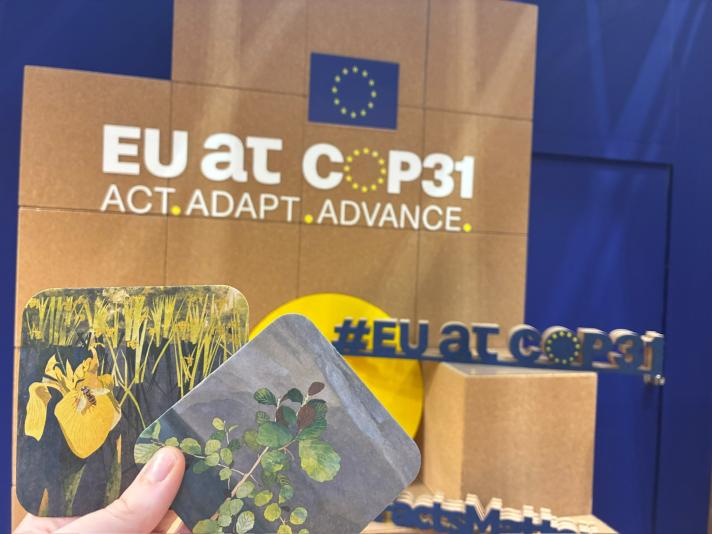
Going into the conference, the EU and its 27 Member States set out to turn ambition into action and speed up progress towards the Paris Agreement’s goals of keeping global warming well below 2 °C.
What COP31 put in the spotlight
After two weeks of discussions, negotiators in Antalya were unable to agree on an overall package to make progress on moving away from fossil fuels and increasing climate finance. More than 130 parties, including the EU, stood firm on the need to limit global warming and called for a fair, clean transition away from fossil fuels.
While COP31 may not have secured the broad political agreement that many had hoped for, it put important issues in the spotlight and made progress in several areas.
The EU endorsed the 35-by-35 Global Electrification Pledge, which aims to increase the share of global energy use coming from electricity by 35% by 2035. The EU is already a world leader in electrification, with around 70% of the EU's electricity already coming from homegrown clean sources.
Throughout COP31, the EU continued to push for climate finance to help countries cut emissions and adapt to climate change, as parties agreed to update the Adaptation Fund. The EU signed an agreement to mobilise up to €1 billion in investments and agreed to put €25 million towards the Fund for responding to Loss and Damage.
It also supported new efforts to cut emissions from buildings and industry, expand geothermal energy, reduce powerful greenhouse gases, and ensure countries report properly on their progress.
Turning ambition into action in local communities
So, what do these global discussions mean for people and communities in Europe?
Away from the political negotiations, side events made the vital link between international commitments and action on the ground.
European Climate Pact Ambassadors held a press conference and took part in many events connecting international climate stakeholders.
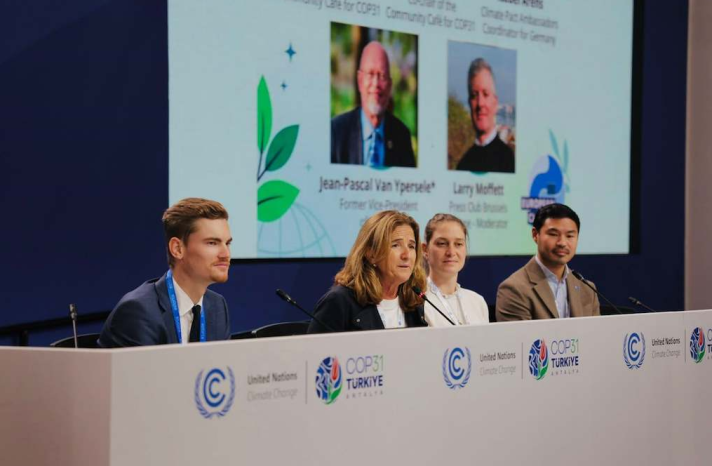
The Pact also hosted an event in Antalya, which shared experiences of citizen engagement, environmental initiatives, education and entrepreneurship. This event was moderated by Pact Ambassador Carmen Marqués Ruiz. Speakers included Pact Ambassadors Lydia Cumiskey, Mark Skljarov and Andrea Briones.
The lesson from this event was clear: effective climate action starts with understanding local needs.
Reflecting on the discussions about climate adaptation and resilience, Lydia says:
‘Citizens are the experts in their own places, and preparing starts on our doorsteps: getting to know our neighbours, signing up for local alerts and talking together about how to be ready, because neighbours are often the first responders.’
‘Those local connections, built through shared stories, culture and lived experience, can also drive wider climate action, creating the social cohesion that makes communities more resilient,’ she adds.
Mark agrees: ‘We need to remind ourselves that the local context matters most, because the risks people need to prepare for depend on the conditions in their own community.’
‘For COP31’s commitments to translate into meaningful action, local communities need stronger and sustained cooperation beyond emergency situations,’ Andrea adds.
‘This requires clearly defined roles and responsibilities, as well as coordination beyond reactive crisis responses and continuous risk communication, which in turn can strengthen risk awareness and preparedness, and foster support for climate measures.’
The event also focused heavily on young people, asking how they can turn ideas from their own communities into advice that shapes government decisions.
‘At COP31, we heard numerous examples, including from within the Pact itself, of governments seeking young people’s advice and being willing to adjust their plans in response. This is also where I see the value of bringing research, business and local communities together,’ Mark says.
Reflecting on the outcomes from the COP31 negotiations, he feels communities need to take the initiative by agreeing on what needs to change and putting those ideas into practice. ‘What works locally can then show governments where to focus their efforts and which changes are worth supporting more widely.’
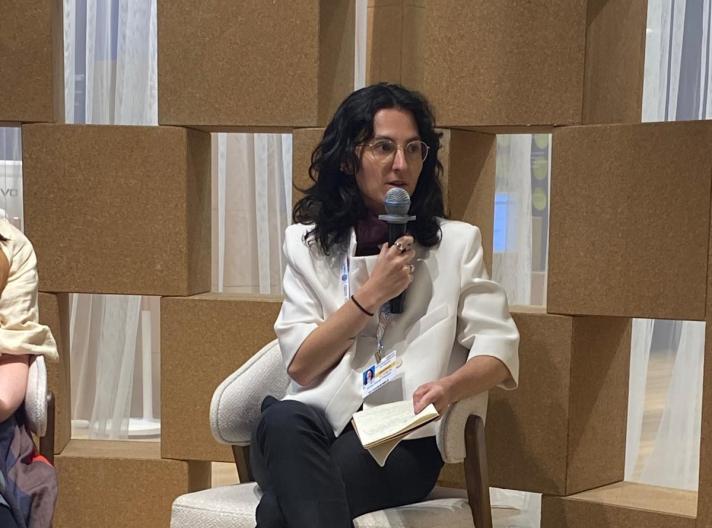
‘For COP31’s commitments to translate into meaningful action, local communities need stronger and sustained cooperation beyond emergency situations.’
Andrea Briones, European Climate Pact Ambassador
The importance of reliable information and communication
A second lesson for communities is that effective climate action depends on information people can trust.
Pact Ambassador Giulia Marzetti spoke at a session on Countering disinformation during extreme weather events, which zoomed in further on the role of communication.
‘What matters most in the first hours is what is happening, what to do now, and where to get help,’ Giulia says.
‘That means evacuation routes, shelters, and water and health advice, from one clearly named source, in people’s own language.’
Disinformation can also disrupt the response to extreme weather events.
‘When false claims undermine a warning or invent a threat, people can panic or ignore the instructions that protect them,’ Giulia explains.
The other risk is a more fundamental, long-term one.
‘When the link to climate change is denied, nobody is held accountable and preparedness slips,’ she adds. ‘Survivors can also be hurt again by what they see online, and AI-generated images and videos can spread faster than official warnings.’
‘What stuck with me while moderating this session with journalists and speakers from all four corners of the world is that lessons were transferable and preparedness is key,’ Giulia adds.
Participants discussed an example from Nepal, where a UNESCO-supported project introduced a fact-checking desk focusing on climate information. This meant trained journalists were ready to react and support the response to the flash floods of 2026.
‘Pre-bunking, which aims to prepare audiences to recognise and resist information risks, is also very useful,’ she says.
As for what local communities can do, Giulia says local organisations can be the ‘trusted messenger’, using instant message groups, local radio, and also word of mouth, which can help reach older neighbours.
Using technology responsibly
Technology and local data can also help communities understand climate risks and choose the right response.
Pact Ambassador Phoebe Koundouri also attended COP31 and spoke at an event on artificial intelligence (AI) and digital public infrastructure for climate action.
This session focused on how to make the most of AI and local data to support decarbonisation and climate action.
At the event, Phoebe discussed examples such as Digital Twins, which simulate climate impacts and test out different solutions, and Living Labs, which connect scientific evidence with local knowledge to help communities design solutions that are fair, affordable and resilient. These examples are similar to the European Climate Viewer and the Mission Solutions Explorer, two tools launched as part of the EU Framework for Climate Resilience.
Reflecting on COP31 and UN SDSN’s recent assessment of 128 countries, Phoebe notes that even if countries fully implement their existing climate commitments, as set out in their Nationally Determined Contributions, this will leave around 15 billion tonnes of energy-related CO₂ emissions in 2050.
‘This reveals the urgent need for more ambitious, integrated and investable solutions,’ she says, which are key to continue driving down emissions.
‘AI can transform complex climate, environmental and socioeconomic data into actionable intelligence,’ Phoebe explains.
‘This enables communities to anticipate risks, evaluate adaptation strategies and prioritise investments that protect people, ecosystems and livelihoods.’
‘While AI offers transformative opportunities for climate action, its own environmental footprint, particularly the energy and water demands of data centres, must be addressed through clean energy, resource efficiency and responsible deployment,’ she adds.
What comes next
COP31 will be judged by what happens next.
As Lydia Cumiskey says, reflecting on the outcomes:
‘COP31 ended without an overarching agreement, so communities need to be empowered from the bottom up. That means real, everyday conversations about waste, emissions, biodiversity loss, nature-based solutions that protect us from floods and restore our lands and waters, and making sure funding reaches local initiatives.’
Local communities can drive change by adapting to the new realities of climate change and building resilience from the ground up, ensuring the ambition shown by the EU and Pact Ambassadors at COP31 leads to real progress.
The message from the Pact Ambassadors in Antalya is simple: communities do not have to wait for global agreements to act. By drawing on local knowledge, sharing reliable information and using the right tools, people can prepare for climate risks and turn ambition into practical action.
The European Climate Pact is here to help with this. With the Pact’s support, you can take practical steps that will make a difference in your community.
If you’re interested in how local communities can become more resilient, read the Pact’s explainer on how the EU’s new framework will help.
And if you want to learn more about how EU and international climate action are financed, sign up for the EU Climate Action Academy’s upcoming webinar.
- Publication date
- 26 November 2026
- Author
- Directorate-General for Climate Action