

This year’s UN Climate Change Conference (COP30) took place from 10 to 21 November in Belém, Brazil. Many European Climate Pact Ambassadors and Partners were there to fly the flag for climate action on the global stage. Here’s what they got up to.
COP30 was a milestone in international climate action. Ten years have passed since the signing of the historic Paris Agreement, where countries agreed to limit global warming to well below 2°C, while pursuing efforts to stay below 1.5°C, yet the need to tackle the crisis is more urgent than ever.
After two weeks of negotiations in Brazil, here are some of the main outcomes:
- While aiming for more ambition, the EU helped secure an agreement on the need to keep the Paris goals within reach.
- More than 80 countries, including the EU, joined a partnership to transition away from fossil fuels.
- The just transition was a big theme, with more focus on human rights, labour rights, gender equality and inclusion.
- Parties agreed on the Global Mutirão, a collective effort to find and act on climate solutions, and a new Global Implementation Accelerator to help speed up progress on the ground.
- Parties also agreed on climate adaptation indicators to guide and measure implementation progress and called for the tripling of adaptation finance by 2035.
Alongside the key negotiation outcomes of the Conference, countries and organisations launched initiatives from boosting renewable energy to protecting forests. Many Pact Ambassadors and Partners were also at COP30 representing their communities and diving into a variety of themes.
Underrepresented communities
Many Pact Ambassadors and Partners made it their mission to give a voice to those whose voices are not heard often enough in climate discussions. This includes people from local and Indigenous communities as well as young people.
Shortly after joining last month’s Youth Dialogue with Commissioner Hoekstra on the future of climate action, Pact Ambassador Mathilda Rouzé set her sights on increasing youth participation.
“This is crucial, because young people will live the longest with the consequences of today’s decisions,” Mathilda says.
“For climate solutions to be fair and sustainable, it is essential that youth are not only included but genuinely empowered to help shape the future. We are stakeholders whose lives, rights and futures are directly affected by the outcomes of these negotiations.”
The biggest thing Mathilda took away from COP30? The “urgent need to rebuild and strengthen collaborative climate governance globally, but also at the community level”.
“This was reflected in the COP Presidency’s call for a Global Mutirão,” she adds: a “collective, bottom-up mobilisation that reinforces the idea that climate action must be shared, inclusive and grounded in real collaboration”.
As well as supporting the push for a just transition, the EU supported the Global Statement on Gender Equality and Climate Action in Belém, recognising that women and girls often face the greatest climate risks.
"For climate solutions to be fair and sustainable, it is essential that youth are not only included but genuinely empowered to help shape the future." Mathilda Rouzé, European Climate Pact Ambassador
Nature-based solutions to climate change
With COP30 taking place in the heart of the Amazonas, conserving and restoring nature was a focus for many.
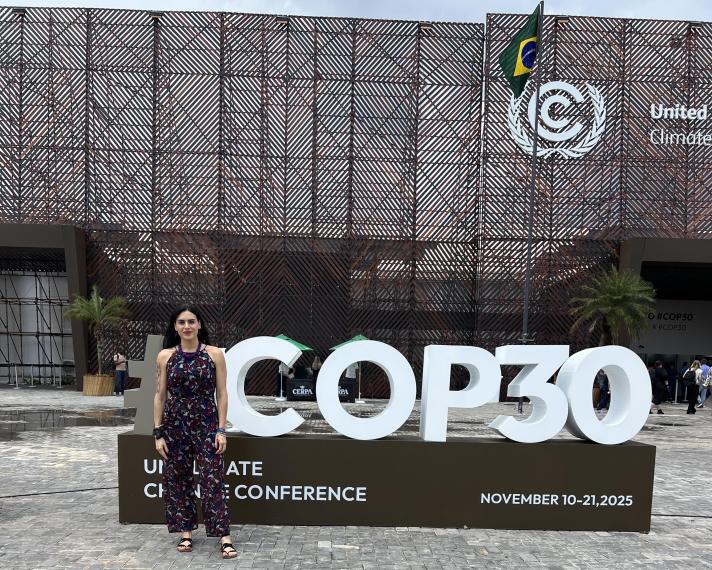
Pact Ambassadors Roberta Bosu and Clara Tomé co-hosted several events including the 6th International Rights of Nature Tribunal, which presented a New Pledge for Mother Nature.
“What shifted at COP30 is that rights of nature moved from the margins to the centre of climate discourse,” Roberta explains. “This is a systemic shift beyond simply replacing fossil fuels.”
“The message was clear: nature's rights are foundational to climate justice, Indigenous sovereignty, and economic transformation – not separate from them.”
“The world is finally ready to listen to what it has always resisted – that nature is not ours to manage, but a living community we belong to”, she says.
Clara says that “keeping fossil fuels in the ground will not come from this COP’s outcome, but from the pressure and leadership of communities and civil society”.
“Recognising Indigenous rights and their land and valuing their traditional knowledge are the most powerful climate solutions,” Clara adds.
Over 2,500 Indigenous representatives attended COP30. “Their resilience, carried across generations in the face of environmental injustice, is one of the most inspiring lessons I take with me and a driving force in my activism moving forward,” Clara reflects.
In Brazil, the EU endorsed the Tropical Forest Forever Facility, which will provide funding to reward the conservation of tropical forests, and signed the Belém Call to Action for the Congo Basin Forests to reverse deforestation and forest degradation in this region by 2030.
“What shifted at COP30 is that rights of nature moved from the margins to the centre of climate discourse. This is a systemic shift beyond simply replacing fossil fuels.” Roberta Bosu, European Climate Pact Ambassador
Culture, arts and storytelling
Meanwhile, several Pact Ambassadors and Partners focused their work on culture, arts and storytelling, which are vital for reminding people of the importance of climate action.
“Culture in all its forms is the most effective way to accelerate climate action,” explains Daniel Cervenka of Pact Partner The Convergence, which organised a Culture Heritage and Arts Thematic Day.
“Culture does not just communicate climate action. It creates the conditions that make climate action possible.” Daniel Cervenka of European Climate Pact Partner The Convergence
“This includes heritage, art, rituals, creative industries, design, education and knowledge systems, which shape how people understand and respond to change.”
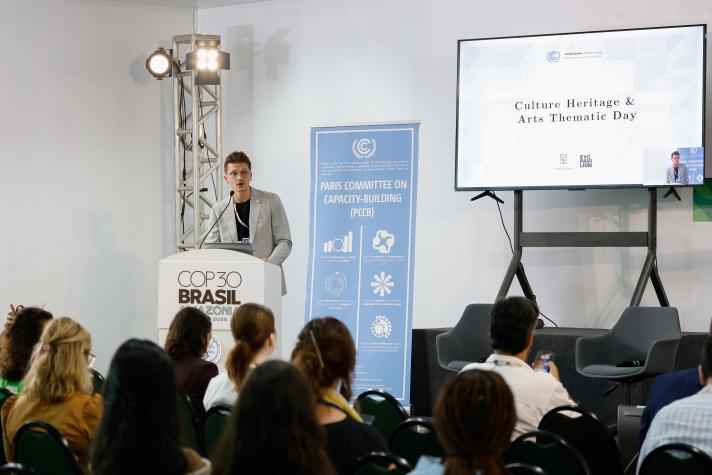
“Cultural diplomacy plays a critical role,” he adds. “It creates the bridges allowing governments, communities, artists, Indigenous leaders, and civil society actors to exchange knowledge, align priorities, and build trust for joint action.”
As for what he took away from COP30, Daniel says that meaningful impact requires strong coordination. “We must map the culture and climate ecosystem and collect further data that shows how cultural systems drive adaptation, resilience, behaviour change, and community engagement,” he says.
“This visibility is essential for the inclusion of culture and stakeholder mapping in the Global Stocktake process and ensuring it becomes a recognised, measurable part of climate policy and implementation.”
“Culture does not just communicate climate action,” Daniel says. “It creates the conditions that make climate action possible.”
Inspired by what our Pact Ambassadors got up to at COP30? Get involved in your own climate action today!
- Publication date
- 27 November 2025
- Author
- Directorate-General for Climate Action