
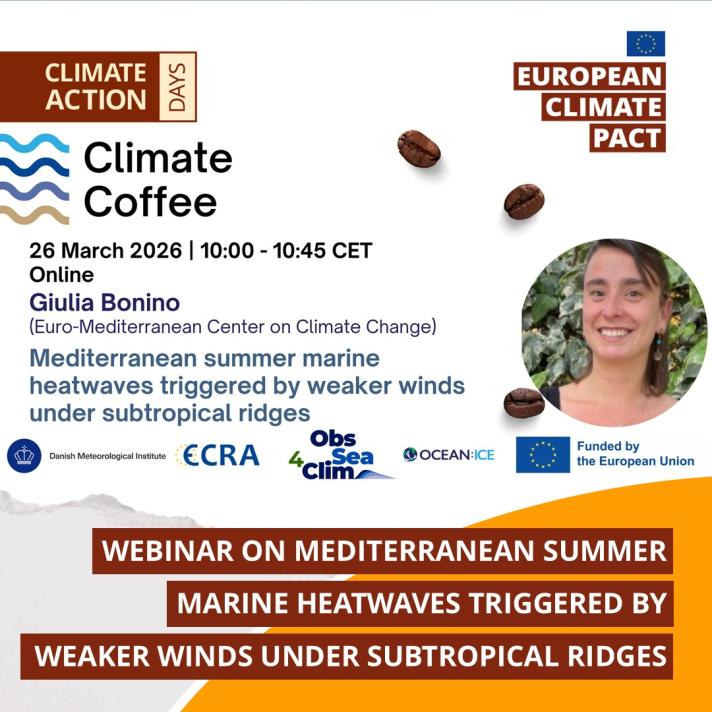
Marine heatwaves, extended periods of elevated sea surface temperature, impact society and ecosystems, and a deeper understanding of their drivers is needed to predict and mitigate adverse effects.
These events can be particularly severe in the Mediterranean Sea during the summer, although the factors controlling their occurrence and duration are not fully understood.
Here, we use a comprehensive multi-decadal macroevent dataset and a cluster analysis to investigate the atmospheric dynamics preceding the largest summer marine heatwaves in the Mediterranean Sea.
Our study identifies the favourable conditions leading up to marine heatwave peaks and reveals that their main synoptic cause in the Mediterranean Sea is the combined effect of persistent subtropical anticyclonic ridges and associated weakening of prevailing wind systems. When persistent subtropical ridges are established over the region, the resulting decrease in wind speeds reduces latent heat loss to the atmosphere, which accounts for over 70% of the total heat flux in affected regions.
This reduction, combined with a moderate increase in short-wave radiation, generates and intensifies marine heatwaves.
This synergistic relationship is a key mechanism for skilfully predicting such atmospheric circulation patterns and realistically simulating their impacts on the marine environment.
- water | youth movement | public awareness campaign | sustainable development
- Thursday 26 March 2026, 16:00 - 16:45 (CET)
- Brussels, Belgium
- Event type
- Climate Action Days
- Event format
- Online
Practical information
- When
- Thursday 26 March 2026, 16:00 - 16:45 (CET)
- Where
- BrusselsBrussels, Belgium
- Languages
- English
- Website
- More information