
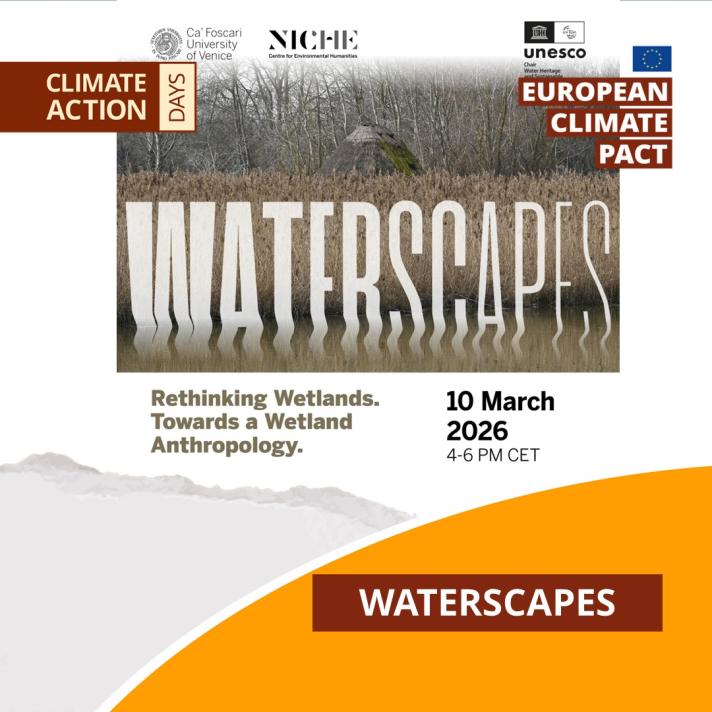
The Waterscapes Research Cluster at NICHE, THE NEW INSTITUTE for Environmental Humanities of Ca’ Foscari University of Venice, investigates the dynamic entwinement of nature, episteme and agency on the basis of the study of territories that are defined by waters, such as the lagoon of Venice, the Kaveri Delta in India, the Mississippi river, the basin of Tenochtitlán (the former Aztec capital and present-day Mexico City) and the Yellow River.
In the Anthropocene, the nature-episteme-labour nexus has evolved to a planetary scale which can be reconstructed only from a cross-cultural perspective. Indeed, according to the geological hypothesis, human technology has become one of the driving forces of the Earth System. The Waterscapes Research Unit addresses the planetary question, at least indirectly, by investigating the complexity of local contexts, the unfolding of which has led to the present ‘geo-anthropological’ conjuncture.
We can call our object of investigation either ‘technological waterscapes’, to stress their natural-artificial hybridity, or 'waterwork landscapes' in order to stress the fact that, although environmental changes occur through the mediation of science and technology, the latter would have no efficacy without human agency, which we see as the decisive force of all societal interactions with the world. How science historically emerges from interactions with the environment and in turn affects environmental history via societal practices, is a central question of this Unit, too. Moreover, all of our cases bear witness to the fact that water flows have been the object of constant human interventions, aimed to tame and regulate their dangerous force as well as to use them for human goals and benefits.
Water-related human activities, from agriculture to fishing, extraction of energy, transportation and supply of drinkable water, are deeply inscribed in the territories that we here consider from the vantage point of Anthropocene Venice. Since they depend on past decisions and societal relations, water-and-land-scapes are the archives of past societal formations and power relations.
What we need to do is to find paths that allow us to comprehend these formations, their evolution and the forms of knowledge they developed, and to understand for what goals, with what effects and for whom they were implemented. Furthermore, we investigate the dependency of the abstractions and structures of knowledge from contexts and practices as well as the functions that secure their legitimacy but also establish the limits of their validity. In this ecocritical spirit, we will desist from narratives that explain world transformations in abstract terms as the unfolding of scientific advance (or technological advance) and its applications.
Rather, by recalibrating our inquiry around the centrality of labour, we regard the perspective of socio-political history of science as a useful intellectual means for a correct comprehension of the connection between epistemology and nature. In fact, to put labour and societal relations at the center of the study of environmental processes implies to address the ambivalent relationships between ourselves, science and technology as well as between our societies and their environments, at the paradoxical encounter of narratives of stewardship and the depletion of resources. This reassessment casts into doubt ideological misrepresentations while opening up a critical knowledge culture. Moreover, as water is indispensable for life, its regulation and control has always constituted a fundamental asset of power as biopower.
We do not consider our cases in isolation but as local developments which, rooted in various cultural pasts, have become increasingly interconnected, eventually reaching a planetary significance, the unity of which has recently found its concept, namely the scientific projection of the Anthropocene as a geo-anthropological system embracing both geology and culture. Yet, this concept is empty, if it is not brought back to its roots, that is, human agency at the confluence of nature, scientific knowledge and technological-transformative labour.
- climate change | inclusion | public awareness campaign | sustainable development
- Tuesday 10 March 2026, 16:00 - 18:00 (CET)
- Venezia, Italy
- Event type
- Climate Action Days
- Event format
- Hybrid
Practical information
- When
- Tuesday 10 March 2026, 16:00 - 18:00 (CET)
- Where
- Aula A, Ca' BottacinC. Crosera, 3911, 30123 Venezia, Italy
- Languages
- English
- Organisers
- NICHE, UNESCO Chair on Water Heritage and Sustainable Development, Ca' Foscari University DFBC
- Website
- More information